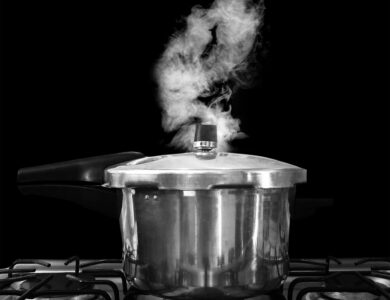

Pressure cookers with spring-loaded silent valves produce significantly less noise than traditional weight-based models because they regulate steam release continuously rather than through sudden bursts. The difference lies in the valve mechanism itself, where controlled micro-venting replaces the sharp acoustic pulses that characterize conventional whistling pressure regulators during cooking cycles.
Selecting a quieter cooker requires understanding how valve design affects both sound output and pressure maintenance rather than relying solely on marketing claims about silence. Technical specifications from manufacturers like Hawkins silent valve technology document decibel reductions achieved through continuous venting systems that maintain steady internal pressure without the repetitive mechanical impacts generating traditional whistle frequencies.
How valve mechanisms determine noise levels
Traditional weight valves operate by accumulating steam pressure until it overcomes the weight’s gravitational force, then releasing suddenly in discrete bursts that create characteristic whistling sounds. Each release cycle generates acoustic energy through rapid gas expansion and mechanical impact between weight and seat, producing peak sound levels typically ranging from 75 to 85 decibels at one meter distance during active regulation phases.
Silent valve designs replace this intermittent operation with calibrated spring mechanisms that allow continuous proportional steam release once operating pressure is reached. The resulting steady-state flow eliminates percussive impacts entirely, reducing peak sound levels to 45-55 decibels while maintaining equivalent pressure regulation accuracy through constant feedback rather than cyclic on-off control strategies.
This fundamental mechanical difference means silent valves cannot be retrofitted onto traditional cooker bodies since seat geometry and vent passage dimensions differ substantially between designs. Buyers seeking lower noise must select purpose-built silent valve models rather than expecting aftermarket modifications to achieve comparable acoustic performance from conventional weight-regulated vessels.

Noise measurement standards and real-world performance
Manufacturer decibel ratings for pressure cookers typically measure peak instantaneous sound during maximum venting rather than time-weighted averages reflecting actual kitchen exposure. This distinction matters because silent valves may show higher sustained background noise despite lower peaks, creating different subjective impressions depending on listener sensitivity to continuous versus intermittent sound patterns.
Independent testing documented in acoustic characterization studies reveals that perceived loudness correlates more strongly with peak-to-average ratio than absolute decibel values alone. Silent valves score better on psychoacoustic metrics despite sometimes measuring similar A-weighted levels because human hearing weights sudden transients more heavily than steady-state signals when assessing annoyance and disturbance potential.
Kitchen acoustics further complicate comparisons since reflective surfaces amplify high-frequency whistle components while absorbing lower-frequency continuous venting noise differently. Real-world performance therefore varies significantly based on room geometry, background noise floors, and individual frequency sensitivities that laboratory measurements cannot fully capture without context-specific calibration adjustments.
Brand-specific implementations and trade-offs
Hawkins Futura series pioneered silent valve adoption in Indian markets with proprietary spring-calibrated regulators designed specifically for local cooking pressures and fuel types. Their implementation achieves measured 20-25 decibel reduction compared to weight-valve equivalents while maintaining compatible gasket dimensions and safety certifications across product lines for user familiarity during transition periods.
Prestige and Butterfly offer competing silent valve designs with varying spring tensions and vent geometries optimized for different price segments and feature sets within their respective portfolios. Budget models sometimes sacrifice some noise reduction to achieve lower manufacturing costs through simplified spring assemblies or reduced machining tolerances that increase flow turbulence and associated broadband noise generation during regulation.
European brands like Fissler and WMF employ alternative approaches using weighted but damped regulators that reduce impact velocity rather than eliminating it entirely through continuous venting. These hybrid designs occupy middle ground between traditional and fully silent operation, offering partial noise reduction while preserving familiar weight-based visual indicators that some users prefer for intuitive pressure monitoring without gauge dependency.
| Valve Design | Peak dB (1m) | Sound Character |
|---|---|---|
| Traditional Weight | 75–85 | Sharp intermittent whistles |
| Spring Silent Valve | 45–55 | Continuous low hiss |
| Damped Weight Hybrid | 60–70 | Muted periodic clicks |
| Electric Multi-Cooker | 35–45 | Near-silent sealed operation |
Maintenance requirements affecting long-term noise performance
Silent valve springs require periodic inspection and replacement as metal fatigue gradually alters calibration tension over hundreds of heating cycles. Worn springs cause erratic pressure regulation manifesting as increased noise from unstable flow dynamics, signaling maintenance needs before complete functional failure compromises cooking results or safety margins.
Mineral deposits from hard water accumulate preferentially in silent valve passages due to continuous low-flow conditions promoting crystallization on precision-machined surfaces. Regular descaling with citric acid solutions prevents deposit buildup that increases flow resistance and turbulence noise while ensuring consistent pressure maintenance throughout the valve’s service life between scheduled replacements.
Gasket condition affects noise indirectly through seal integrity losses that force compensatory venting increases during pressure maintenance phases. Proactive gasket replacement schedules based on usage frequency rather than visible wear signs prevent gradual leakage-induced noise escalation that users often misattribute to valve malfunction when root cause actually stems from degraded sealing surfaces requiring renewal.
Choosing the Quietest Option for Your Kitchen
Spring-loaded silent valve pressure cookers deliver measurably lower peak noise levels than traditional weight-regulated models through continuous steam release mechanisms that eliminate percussive impacts entirely. Verify specific model decibel ratings and read user reviews focusing on real-world kitchen experiences rather than relying solely on manufacturer specifications measured under controlled laboratory conditions. Investing in proper silent valve technology provides meaningful acoustic improvement for noise-sensitive households while maintaining equivalent cooking performance and safety standards expected from quality pressure cooking equipment.
Frequently Asked Questions
Are silent pressure cookers safe compared to traditional whistling models?
Silent valve cookers meet identical safety certification standards as traditional models through redundant backup systems and tested pressure relief mechanisms. Continuous venting actually provides more stable pressure control than intermittent weight valves, reducing thermal cycling stress on vessel components during extended cooking sessions.
Can I convert my existing weight-valve cooker to silent operation?
Retrofitting silent valves onto traditional cookers is not feasible due to incompatible seat geometries and vent passage dimensions between designs. Purchase purpose-built silent valve models instead of attempting unsafe modifications that compromise pressure regulation accuracy and void manufacturer warranties covering critical safety components.
Do electric pressure cookers operate more quietly than stovetop silent valves?
Electric multi-cookers typically measure 10-15 decibels quieter than stovetop silent valves due to sealed operation eliminating continuous venting entirely during pressurized phases. However, they require longer total cooking times and lack direct heat adjustment capability that experienced stovetop users value for precise texture control in traditional recipes.
Why does my silent valve cooker still make some noise during use?
Residual hissing from silent valves indicates normal continuous steam release maintaining regulated pressure rather than malfunction requiring repair. Excessive or irregular noise suggests mineral deposits restricting flow passages or worn springs needing replacement according to manufacturer maintenance schedules for optimal acoustic and functional performance.