
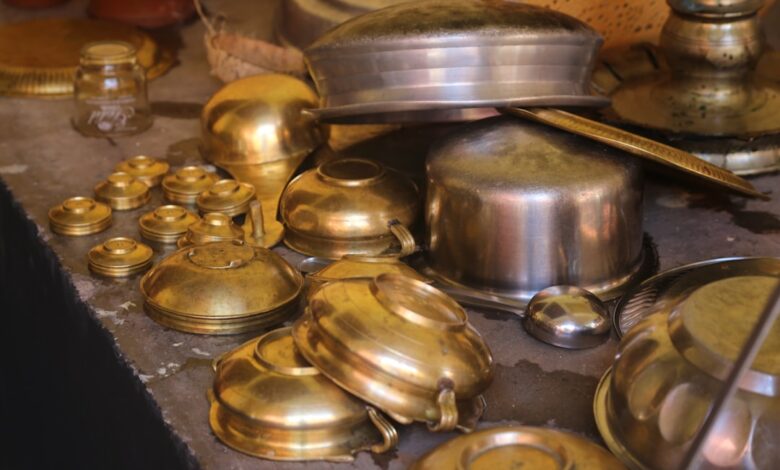
Standard modular cabinets are built around Western saucepans, so a generic organizer fails the first time a wide-handled kadhai or a tall pressure cooker meets a base drawer. The fix is to match each vessel’s exact size and weight against the free space and load limits of pull-out boxes, vertical thali racks, and reinforced shelves.
Cabinet engineering and kitchen ergonomics supply the only measurable numbers here, backed by standard modular kitchen dimensions for Indian base units. Vertical racks save depth yet risk toppling thalis, while strong pull-outs depend on costly channels. A dimensional audit of your own vessels answers how to store Indian cookware and utensils in a small kitchen.
Why standard modular cabinets fail Indian cookware
The mismatch begins inside the cabinet. Indian base units typically run 22 to 24 inches deep and 32 to 36 inches tall, a volume shaped around Western saucepans whose single long handle slides neatly into that depth.
Indian cookware breaks that assumption at three points. A kadhai’s dual-loop handles widen its footprint beyond the internal clearance of sliding tracks when it sits sideways, a pressure cooker’s domed lid adds height that shallow trays cannot absorb, and thali diameters exceed standard divider spacing.
Weight compounds the fit problem. A 5-litre steel pressure cooker or a cast-iron kadhai often weighs 3–5kg empty, and stacked vessels can exceed the roughly 15–20kg dynamic load limit — the weight the basket carries while moving — of standard PVC-coated wire pull-outs. That overload is what bends tracks and jams drawers in a kitchen cabinet for Indian vessels.
Buyers who load a new modular kitchen with family cookware consistently notice the first sag appearing at the wire basket’s centre. The mesh carries point loads with no floor support beneath, so deformation begins exactly where the heaviest vessel sits.

The dimensional audit: measuring your kadhais, cookers, and thalis
Organizers are sold by external cabinet width, such as 18-inch or 24-inch, but the usable internal space shrinks once sliding channels and cabinet walls take their share. Examining an empty pull-out reveals exactly how much width the hardware steals from the advertised size.
Three measurements matter before buying any kadhai storage idea in India. A standard 3L kadhai’s handle-to-handle span often reaches 16–18 inches, which an 18-inch internal drawer cannot take sideways, while a thali set needs both diameter and stacked-height clearance.
A 5L pressure cooker stands roughly 10–11 inches tall with its lid on, so among pressure cooker storage solutions it demands deep base drawers rather than shallow trays.
Add dynamic clearance, the extra space your hand and wrist need to lift a heavy vessel straight out without scraping the sides. A drawer that fits a kadhai on paper can still fail this lift test.
Check drawer fit by measuring your largest kadhai handle-to-handle and comparing that span with the drawer’s internal width. If the span exceeds the internal width, the vessel belongs in vertical storage or on an open shelf, not a sliding drawer.
Pull-out drawers vs vertical racks: matching the organizer to the vessel weight
Pull-out tandem boxes ride on heavy-duty telescopic channels, paired steel runners rated by dynamic load, the weight they can carry while moving, typically 30–40kg in hardware aimed at Indian kitchens. That capacity lets a loaded drawer bring a 5L cooker or cast-iron kadhai out to you, removing the bend-and-reach into dark corners.
The rating printed on the runner decides everything. Installation guides list telescopic channel load capacity in tiers around 20kg and 45kg, so a channel chosen on price alone can halve the safe load before the first vessel goes in.
Vertical thali and plate organizer designs work the opposite way, using the roughly 12-inch depth of wall cabinets or narrow pull-outs to file thalis and katoris upright like documents in a tray. They reclaim wide horizontal drawer space and stop stacked piles from collapsing, but pulling one thali can topple the row unless the base is rigid and weighted.
Standard wire baskets sag under 15kg of steel because the mesh spans unsupported between the side rails, while tandem boxes pass the load down to the cabinet floor. After a year of daily use, a bowed heavy cookware storage rack typically shows its fatigue at the centre seam, where the heaviest stack rested.
The scale below lines up each organizer type against its typical dynamic capacity and the Indian cookware it can safely carry.
The takeaway from the scale is simple: vertical utensil storage for an Indian kitchen wins on space, yet weight decides whether a pull-out earns the heavy vessels.
The “stacking thalis” trap that ruins drawer tracks
Stacking ten to fifteen steel thalis flat in a deep drawer concentrates roughly 8–10kg of dead weight onto a single 12×12-inch footprint. That point load exceeds what standard wire basket bottoms are built to carry, so the mesh bows within months.
Retrieval defeats the drawer’s purpose too, because reaching the bottom thali means lifting the whole stack. Vertical slotting with acrylic or steel dividers spreads the weight across the drawer’s base track and returns file-like access.
How to store Indian cookware and utensils in a small kitchen: the decision matrix
Read the matrix across from your vessel to the organizer, internal dimension, and load rating it demands. The figures are planning estimates drawn from typical modular hardware tiers, so verify your own cabinet’s internal width before ordering.
| Cookware type | Required organizer | Minimum internal cabinet dimension | Weight capacity requirement |
|---|---|---|---|
| 5L pressure cooker | Deep tandem box | Approximately 12in wide × 12in deep, 12in+ height | Channels typically rated 35–45kg dynamic |
| 3L kadhai | Open shelf or wide pull-out | Handle span plus roughly 2in lift clearance, often 20in+ internal width | Shelf or runner rated approximately 25kg or more |
| Steel thali set | Vertical slot divider | Approximately 12in depth, about 2in per slot | Load distributed across base track, typically 8–12kg |
| Cast-iron tawa | Heavy-duty base pull-out or reinforced open shelf | Approximately 14in deep, low shelf height | Floor-supported, typically 40kg+ rated |
Step 1: Measure the vessel, not the brochure
Take handle span, lidded height, and stacked height before shopping, because brochures quote external widths.
Step 2: Match the internal dimension column
Compare your numbers against the minimum clearances, remembering that channels and walls steal usable space.
Step 3: Confirm the runner rating exceeds filled weight
Drawers accumulate stacks over time, so buy the next rating tier above your calculated load.
The matrix’s hardest lesson is that the heaviest vessels belong on floor-supported or high-rated hardware, never on decorative wire mesh. Buyers who move thalis from flat stacks to vertical slots consistently notice the drawer glides lighter, because a point load becomes a distributed track load. Once the right organizer is chosen for each vessel, the broader spatial audit in How to Measure and Maximize Every Inch of Storage in a Small Indian Kitchen Without Renovation sets the cabinet measurements and workflow zones needed to install them well.
What this means for your kitchen
Standard modular cabinets were never dimensioned for the wide handles, tall lids, and heavy steel of Indian cookware, which is why generic organizers jam, sag, or scratch vessels. Audit your heaviest kadhais and cookers by handle span and weight, then match them to heavy-duty tandem boxes or vertical slotting instead of standard wire pull-outs. Weight-rated hardware and dividers remove the daily friction of jammed drawers and back-straining reaches, turning the modular kitchen into a workspace built for heavy Indian cooking.
Frequently Asked Questions
Can I store a 5-liter pressure cooker in a standard 18-inch wide modular kitchen drawer?
It depends on handle span against internal clearance, because an 18-inch cabinet yields only about 15–16 inches of drawer width. A 5-litre cooker with dual handles often exceeds that span, needing a 24-inch cabinet or open shelf.
Are acrylic vertical plate stands strong enough to hold heavy stainless steel thalis?
Thin acrylic stands are not enough, because ten steel thalis can weigh 4–5kg and bow or crack slim dividers over time. Choose weighted acrylic bases of 5mm or more, or steel wire slots anchored to the drawer base.
How do I prevent cast-iron kadhais and tawas from rusting when stored in deep pull-out cabinets?
Enclosed cabinets trap steam, so moisture settles on porous iron and speeds up rust where open shelving would let it dry. Dry and lightly oil cast iron before storage, and keep it out of the under-sink cabinet.
What is the minimum weight capacity I should look for in telescopic channels for Indian cookware?
Look for channels rated at 35–45kg dynamic load or more, because a kadhai, cooker, and stacked lids easily pass 15kg and bow 20kg runners. Check the dynamic rating on the hardware packaging, not just the static number.
