
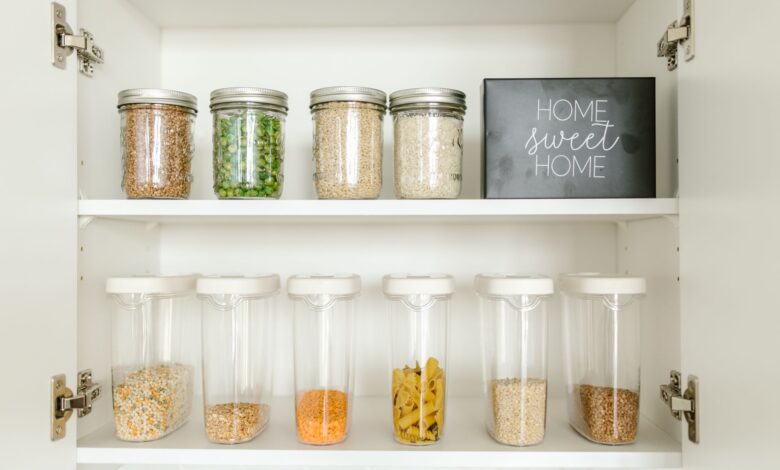
Reaching for a buried container while cooking forces you to dismantle an entire stack just to grab one item. Real space-saving designs minimize the physical effort needed to pull a specific jar without toppling the rest. Basic kitchen workflow rules dictate that daily ingredients must remain accessible in a single motion.
Interlocking lids might look neat on a display shelf, but they create awkward dead space during actual meal prep. Evaluating storage requires measuring the true volume efficiency of your exact cabinet depth rather than trusting printed labels. Ignoring these physical measurements guarantees a frustrating routine every time you cook.
The accessibility bottleneck in stackable container sets
Interlocking designs force you to dismantle an entire column just to reach a jar trapped at the bottom. This physical friction compounds heavily when you are rushing through complex meal preparations.
People who use these sets for daily ingredients consistently notice their frustration peaking after the third or fourth unstacking. Reaching a small vessel trapped beneath larger ones requires lifting and moving multiple separate lids and bases.
Single-layer or nesting designs contrast sharply because every container remains independently accessible from the front of the shelf. Smaller bowls simply lift out without disturbing their neighbors, keeping your cooking rhythm intact.
Lids on these sets often require specific rotational alignment to lock securely into place. This adds seconds of fine-motor friction per use, which quickly turns into minutes of lost time during elaborate meal prep.
Nesting vs uniform shapes: maximizing standard Indian cabinet depths
Standard modular kitchens typically feature modular kitchen cabinet dimensions of roughly 340mm for wall units and 580mm for base modules. Container footprints must align cleanly with these fixed depths to avoid protruding into walkways or blocking closing doors.
Square or rectangular uniform containers maximize floor space in deep base cabinets because their flat edges align perfectly. Round nesting containers leave significant dead air gaps between them due to their curved geometry.
The mathematical geometric packing fraction of circles explains this physical inefficiency. This principle shows that round shapes inherently waste roughly 21% of the horizontal footprint compared to square vessels.
The trade-off becomes obvious once the containers are actually filled and lined up on the shelf. Nesting sets save immense vertical space when empty, but their curved sides prevent tight horizontal packing when full of grain.
People evaluating these footprints benefit from the precise measurement framework covered in How to Measure and Maximize Every Inch of Storage in a Small Indian Kitchen Without Renovation. Applying this spatial math correctly ensures you do not waste valuable shelf area.
The visual guide above maps the most reliable shape choice to your exact cabinet depth. Deep base shelves handle square stacks easily, while shallow wall drawers demand the low-profile footprint of rectangular nesting sets.
Stability and the modular kitchen shelf limit
Storing heavy glass or thin plastic containers stacked three-high on a pull-out wire shelf introduces severe structural risks. The base cabinet carcass depth and shelf load limits dictate exactly how much vibration the shelving can absorb.
Stack shift occurs when the vibration of closing a heavy drawer causes a tall tower of containers to slide and shatter. A higher centre of gravity transfers much more kinetic energy through the stack during a sudden drawer slam.
Single-layer storage with a dedicated lid rack remains inherently safer for heavy glass vessels in busy kitchens. Nesting designs that do not stack vertically when full also eliminate this toppling hazard entirely.
Check the internal shelf depth by measuring from the back wall to the front lip and subtracting 20mm for finger clearance. This simple deduction ensures lids can be removed easily without hitting the cabinet door hinges.
Container shape and size decision matrix for Indian cabinets
Use this decision matrix to match container geometry to your specific cabinet dimensions and daily retrieval needs. Measure your shelf depth first, then cross-reference with your primary storage requirement to select the right configuration.
Square uniform containers
Space efficiency scores highest in deep base cabinets, offering excellent volume utilization for dry goods. Accessibility remains strong as long as they stay single-layer, but stability drops sharply when stacked on wire pull-outs.
Rectangular nesting sets
These excel in shallow wall drawers where depth is restricted but horizontal width is plentiful. Space efficiency is moderate due to tapered walls, yet accessibility and stability remain consistently high since they avoid vertical stacking.
Round nesting bowls
Space efficiency suffers from the geometric packing penalty mentioned earlier in the guide. However, accessibility for spherical snacks is superior, and stability is excellent because their low centre of gravity resists sliding on smooth shelves.
Interlocking stackable towers
While they offer the highest theoretical vertical space efficiency, their accessibility score is the lowest due to unstacking friction. Stability is poor on vibrating wire shelves, making them best suited for stationary corner cabinets rather than daily-use pull-outs.
The last check
True cabinet efficiency depends on balancing vertical space savings against the daily friction of retrieving ingredients. Measure your exact shelf depth and choose uniform shapes for deep base cabinets or nesting designs for shallow drawers. Ignoring this spatial geometry leads to wasted volume and frustrating unstacking routines during every meal prep.
Frequently Asked Questions
Are square containers actually better than round ones for storing round Indian snacks like laddoos?
While square shapes maximize shelf space, round nesting containers are functionally superior for storing spherical items like laddoos. Curved interior walls prevent delicate snacks from getting crushed against sharp corners during retrieval.
Square edges create dead zones where round sweets shift and break against the hard plastic walls. Choosing cylindrical vessels for festive treats eliminates this friction and ensures an intact presentation.
How do I organize lids for single-layer containers without losing them in the cabinet?
Deep cabinets cause lid drift, where matching tops slide behind heavier bases and disappear completely. Installing a vertical tension-rod divider stores lids upright, keeping them visible without consuming horizontal shelf space.
Will stackable glass containers scratch each other over time?
Glass friction during unstacking inevitably causes micro-scratches and gradual clouding on the transparent surfaces. Placing a thin silicone liner between stacked vessels prevents this abrasive wear if you maintain a vertical configuration.
