
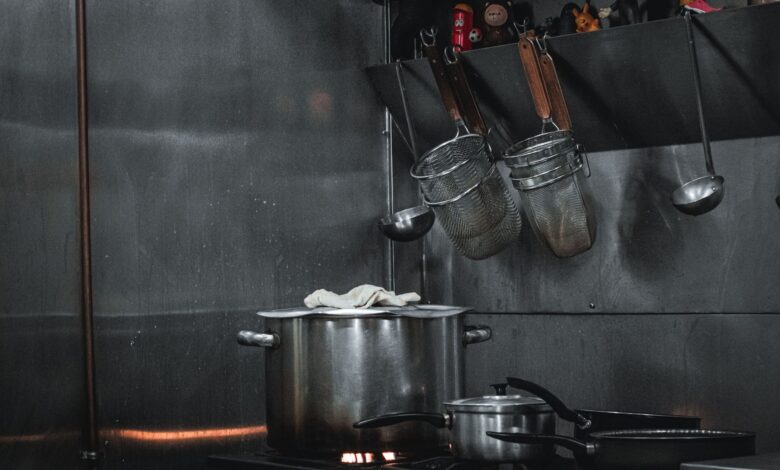
In a joint-family kitchen, wet brass handis, copper thalis, and a heavy pressure cooker land on the same rack every night, while airborne oil, turmeric dust, and steam settle across its wires. The rack that survives that routine is built from metal that holds weight and shrugs off acidic, oily residue — not one that merely carries a “rust-proof” sticker.
Answering which kitchen rack is most durable for heavy Indian cooking is a materials-engineering question, because wire shelving load capacity data and grade metallurgy expose why “heavy duty” stickers lie. The hidden failure is a weld point snapping when a 15kg cooker sits on mesh sized for 2kg jars. Reading gauge and coating thickness before checkout is what separates a workhorse from a landfill addition.
The hostile environment of an Indian joint-family kitchen
The damage starts in the air, because every deep-fry session throws lipid aerosols across the room and alkaline detergents leave residues on the same surfaces. Constant steam then binds both into a thin electrolytic film on the metal, which drives oxidation far faster than plain humidity would.
After a few months of regular use, a tacky yellow film typically appears first at weld points and corners. Those geometries trap aerosols that wiping misses, so the film holds moisture against the metal all day.
Then add the weight, because wet brass handis and heavy-gauge cookers stack into loads that spice-shelf wire was never sized for, pressing constant mechanical stress into every rung and weld. Research on polymer-coated steel under severe environment corrosion conditions confirms how quickly heat, chlorides, and humidity together accelerate coating breakdown.

Decoding rack materials for heavy Indian cookware
Stainless steel is not one material, and the grade decides how the rack ages. Both 202 and 304 rely on chromium to form a self-repairing passive oxide layer, but nickel is what stabilizes that layer against chlorides. Budget racks typically use 202, whose lower nickel leaves welded joints — where heat already disrupted the oxide — open to crevice corrosion, the failure mode documented in analyses of welded joint corrosion.
PVC-coated mild steel carries a subtler trap, because the coating is genuinely waterproof on day one, which is why the rack shines in the showroom. Sliding a heavy kadhai across it tears the polymer, though, and each micro-tear traps moisture and alkaline cleaner against the steel core with no airflow to dry it.
On Amazon.in verified purchases for budget wire racks, buyers repeatedly report the coating flaking and rust staining the floor, and as one reviewer put it, “issues with the paint peeling off” appeared within months. The engineering discussion on PVC sleeve corrosion explains why: once the sleeve is breached, the trapped electrolyte corrodes the core from the inside out.
Buyers who have owned coated racks for about a year consistently notice rust bleeding through plastic that still looks intact, because the corrosion starts at the core rather than the surface.
Wood and engineered MDF fail differently but just as surely, because both are hygroscopic — they swell with steam and absorb lipid residues. A shelf that carried dry boxes sag-warps within seasons once wet cookware and oil reach it.
The cross-section below shows what happens inside a torn coating once utensils start sliding across it.
Rust blooms from inside out
Layered cross-section: once the coating tears, the trapped film corrodes the core while the surface still looks fine.
Read the three layers as a single warning, because a coated rack can look perfect on the outside while it loses its core.
Why “heavy duty” labels lie: understanding wire gauge and weld points
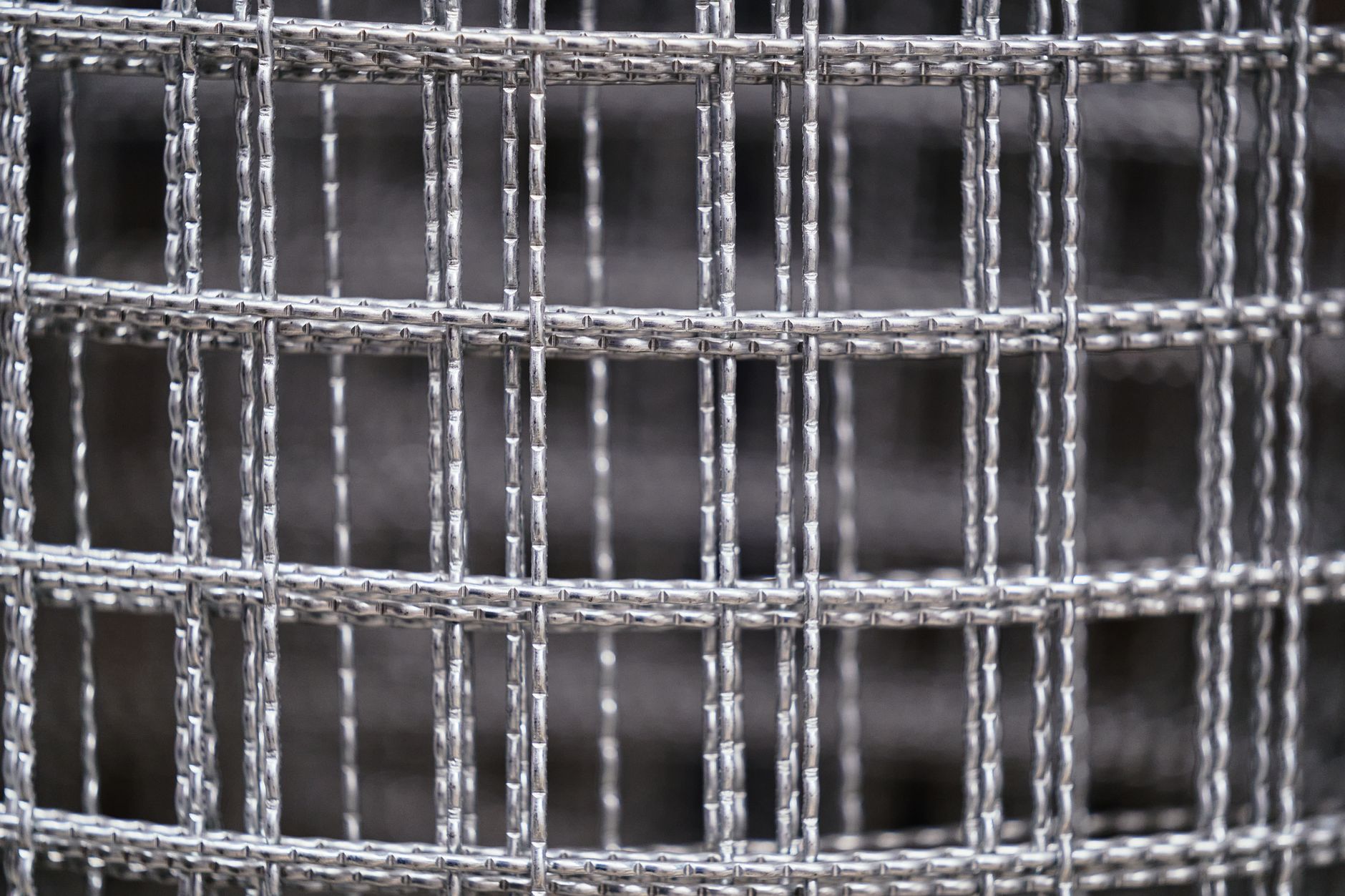
“Heavy duty” is a marketing term with no standardized gauge behind it, so the label alone tells you nothing. Wire shelving fails in two predictable ways: creep, where a constant point load slowly bows a thin rung past its yield strength, and weld-point shearing, where an impact load snaps an incompletely fused joint.
The distinction that matters is point load versus uniform load, since a shelf rated for 80kg distributed may still bow under a 10kg wet grinder whose base concentrates the entire weight onto two or three rungs. Wire shelving load capacity figures only mean something when they state both values and the wire thickness behind them.
Examining a bowed shelf reveals the cost-cutting pattern, because the outer rim stays straight while inner rungs sag at mid-span. Manufacturers often specify thick rim wire for looks and thin rungs to save weight and cost.
Weld quality is the second silent variable, because porous or undersized welds act as pre-cracked points under the daily lift-and-set of heavy cookware. The rack therefore rarely fails at the wire’s middle; it fails at the joint.
Once a rack passes these checks, the companion guide to kitchen organizers that actually fit Indian cookware shows how to load thalis, kadhais, and cookers so the weight lands on the frame rather than the mesh.
The wire gauge check most buying guides skip
Check the inner rungs by pressing firmly at mid-span with your thumb before paying. Any visible flex, or an audible creak at the welds, means the rung gauge is too thin to carry wet, heavy utensils without creeping.
Also compare rim and rung thickness by eye, because a thick frame wrapped around pencil-thin rungs is the classic weight-saving build. Weld spots should look fully fused, not dotted with pores.
Cleaning oil and turmeric buildup without destroying the rack finish
Polymerized oil and turmeric dust form a sticky lacquer that invites scrubbing, and scrubbing is exactly what destroys the rack. Abrasive pads strip stainless steel’s passive chromium layer and tear PVC coatings, exposing bare metal that flash-rusts within hours of the next steam cycle.
Examining a dull, rust-flecked patch beside a shiny one usually reveals the scrub line, because the abrasive removed the protective layer, not just the stain.
The safer protocol is chemical rather than mechanical, because an alkaline degreaser breaks lipid bonds so the film lifts with a soft cloth and warm water, leaving the passivation layer and coating intact. Where a maker specifies particular cleaners, the product’s own instruction manual overrides any general rule.
Kitchen rack durability scoring rubric
Score any candidate rack across the four dimensions below before price enters the conversation. The table compresses the metallurgy and structural logic above into one shelf-side reference, so treat its load and warranty figures as typical market values, not guarantees.
| Material | Load behaviour (point vs uniform) | Rust and cleaning resistance | Typical warranty reality |
|---|---|---|---|
| 304 stainless steel | High when rungs reach approximately 3mm or more; welds hold | Resists oil and alkaline cleaners; turmeric wipes off | Typically 1–5 years, occasionally covers rust |
| 202 stainless steel | Similar frame strength | Crevice corrosion at welds in humid kitchens; stains linger | Often replacement-only, rarely covers rust |
| PVC-coated mild steel | Bows once tears let the core corrode | Coating traps residue; tears flash-rust | Usually months; coating damage voids it |
| Wood or MDF | Warps under heavy wet loads | Absorbs oil, swells, resists sanitizing | Rarely meaningful in wet kitchens |
Read the table diagonally, because 304 wins on rust and cleaning but costs most, while 202 matches it structurally yet loses at the welds, as the welded joint corrosion pattern above shows. Coated steel starts strong and dies from the inside, and wood never recovers from steam.
Examining a listing’s spec table reveals whether the seller publishes rung gauge and per-shelf kilograms, the two numbers a durability verdict actually rests on. Their absence usually means the frame cannot carry them.
Apply the score as a knockout test, so any rack that cannot state its load, or that pairs a mild-steel core with a joint-family steam zone, is out regardless of price.
Before you buy
The racks that survive a joint-family kitchen are decided by rung gauge, weld quality, and the nickel in the grade — never by a “heavy duty” sticker. Press the inner rungs before paying, read the spec table for stated loads, and put 304 steel or a verified thick-gauge frame in the steam zone. Done properly, one rack outlives several cheap replacements; skipped, the season ends with you repainting rust.
Frequently Asked Questions
Does a magnet test reliably identify 304 stainless steel in kitchen racks?
No — 304 and 202 are both austenitic, so neither reliably attracts a magnet, and cold-worked rungs can induce slight magnetism in either grade. Trust a laser-etched stamp or austenitic stainless steel magnetism data over a fridge magnet.
Can I use a PVC-coated wire rack if I only store dry, lightweight spice boxes?
Yes — in a dry zone the coating stays intact, since without wet utensils abrading it, moisture never reaches the mild steel core. Keep the rack away from stove and sink, where steam and oil breach the PVC within months.
How do I fix a rust spot on a stainless steel kitchen rack before it spreads?
Dissolve the spot with diluted white vinegar or a citric acid passivation gel, then rinse and dry it so chromium can rebuild the oxide layer. Never scrub with steel wool, because embedded carbon particles guarantee worse rust later.
